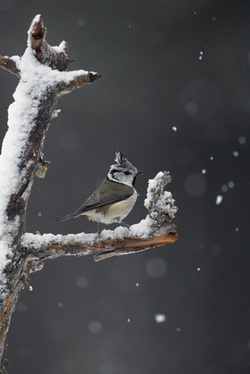
A species truely special to Strathspey and Inverness-shire, the Crested Tit is every birder and photographer's favourite without any doubt. It resides as the emblem of the local Abernethy Primary school where my son Mattias attends and indeed, we see or hear them most days on the school run!
A very charismatic and charming bird, though never to be under-estimated as "easy" to see well! It very much depends on the time of year and weather,they can suddenly vanish from a site where they've been showing well for weeks or on some days just seem to be everywhere, calling loudly. Call is undoubtedly the best way to find them, I probably find 90% of Cresties by hearing them first in the forest. In winter they frequent the local feeders and can be very approachable, there are many sites locally where you can get fantastic views as they forage with the other tits. By Spring they can become incredibly elusive once nesting and seem to just vanish from regular sites, so much more fieldwork and effort is needed to find them as they will only be at or near their nest site and call very little. If you are wanting to photograph them at this time of year, bear in mind they are a schedule one protected species and it's very likely you will be close to their nest, which does require a licence.
One remarkable characteristic of Cresties is they are very inquisitive and seem to respond to the sound of the human voice, so ironically the more noise you make in the forest the more chance of seeing one! They can often come right down to eye level feet away, though they rarely stay long and are gone back in to the tree tops in the blink of an eye. "Birds of Scotland 2012" lists them as having a population of between five and seven thousand individuals with up to two thousand breeding pairs which seems to remain relatively stable. As they nest in dead trees, Great-Spotted Woodpeckers can be dangerous predator of young and eggs, however this doesn't seem to have a significant impact on the population. They also seem quite adept at surviving even the harshest winters and can often be one of the only birds you see and hear in the forest in depths of a severe cold snap when seeing them amongst the frosted branches is something very special indeed.
A very charismatic and charming bird, though never to be under-estimated as "easy" to see well! It very much depends on the time of year and weather,they can suddenly vanish from a site where they've been showing well for weeks or on some days just seem to be everywhere, calling loudly. Call is undoubtedly the best way to find them, I probably find 90% of Cresties by hearing them first in the forest. In winter they frequent the local feeders and can be very approachable, there are many sites locally where you can get fantastic views as they forage with the other tits. By Spring they can become incredibly elusive once nesting and seem to just vanish from regular sites, so much more fieldwork and effort is needed to find them as they will only be at or near their nest site and call very little. If you are wanting to photograph them at this time of year, bear in mind they are a schedule one protected species and it's very likely you will be close to their nest, which does require a licence.
One remarkable characteristic of Cresties is they are very inquisitive and seem to respond to the sound of the human voice, so ironically the more noise you make in the forest the more chance of seeing one! They can often come right down to eye level feet away, though they rarely stay long and are gone back in to the tree tops in the blink of an eye. "Birds of Scotland 2012" lists them as having a population of between five and seven thousand individuals with up to two thousand breeding pairs which seems to remain relatively stable. As they nest in dead trees, Great-Spotted Woodpeckers can be dangerous predator of young and eggs, however this doesn't seem to have a significant impact on the population. They also seem quite adept at surviving even the harshest winters and can often be one of the only birds you see and hear in the forest in depths of a severe cold snap when seeing them amongst the frosted branches is something very special indeed.
 RSS Feed
